
The co-working industry in India is growing at 15% annually, but most space owners are fighting over the same strategies: competitive desk pricing, free coffee, and faster WiFi.
Meanwhile, a small group of operators discovered something far more profitable—and it has nothing to do with lowering prices.
They’re turning underutilized corners into revenue-generating zones by strategically placing statement furniture that members actively pay to use.
The Problem Nobody Talks About
Walk into most premium co-working spaces in Gurgaon or Bangalore, and you’ll see the same pattern: rows of identical desks, generic meeting rooms, and a few bean bags thrown in a corner labeled “breakout zone.” The furniture does its job functionally, but it creates zero competitive advantage.
Here’s what that costs: When a corporate client tours five co-working spaces in a day, they all blur together. The decision comes down to price and location because nothing else differentiates them. You’re competing on the two factors where you have the least margin.
But there’s a hidden cost that’s even bigger. Your members aren’t posting about your space on social media. They’re not bringing clients to your location for meetings. They’re not hosting their own events in your venue. Why? Because there’s nothing visually remarkable to showcase.
The Instagram Test (And Why You’re Failing It)
Here’s a brutal exercise: Search your co-working space’s name on Instagram. Count the number of organic posts from members (not your own marketing account) in the past 30 days.
If that number is under 20, you have an Instagram problem. And an Instagram problem is actually a differentiation problem.
Compare that to a space in Koramangala that invested ₹8 lakhs in three parametric furniture pieces strategically placed in high-traffic zones.
Their member posts jumped from 12 per month to 150 per month. That’s ₹36 lakh in equivalent advertising value annually—from a one-time ₹8 lakh investment.
The Content Creation Corner Strategy
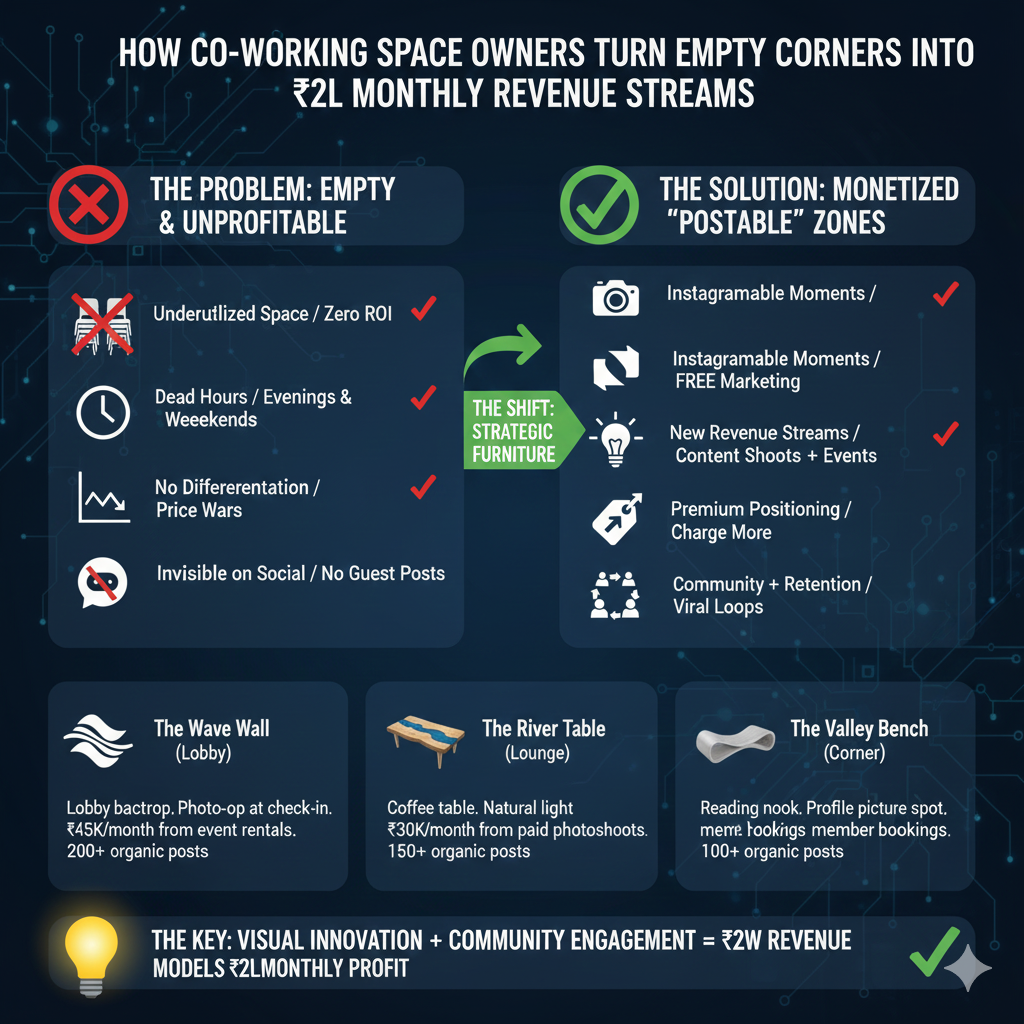
One operator in Noida discovered this by accident. They placed a sculptural wave wall art piece in a naturally lit corner. Within a week, members were asking if they could use that spot for LinkedIn profile photos.
The operator started charging ₹500 per hour for “content creation corner” bookings. The zone now generates ₹45,000 monthly from members who want professional-looking backgrounds for their content—and it’s booked 90 hours a month without any marketing.
The furniture piece cost ₹1.8 lakhs. It paid for itself in four months and has been pure profit since.
But the secondary benefit was bigger: Those members tag the co-working space in their posts. Free marketing reaching exactly the audience you want—other professionals who value aesthetics and might need workspace.
Naming Your Zones Changes Everything
Here’s something most operators miss: You need memorable names for these zones. “Breakout area” or “corner by the window” doesn’t stick in anyone’s mind.
The Noida operator calls their space “The Wave Zone” (named after the wave-pattern wall art). Members now say things like “I’m booking The Wave for a shoot tomorrow” or “Meet me at The Wave.” The zone became part of the space’s identity.
When launching signature zones, consider using tools like AI-powered name generators to develop names that are both memorable and aligned with your brand. The right name makes the zone more shareable—people are more likely to mention “The Valley” or “The River Corner” in their Instagram captions than “meeting room 3.”
The Corporate Event Revenue Stream
Once you have visually distinctive zones, a new revenue stream emerges: off-hours event rentals.
A space in HSR Layout with parametric furniture pieces charges ₹15,000 for evening rentals (6 PM to 10 PM) for small corporate photoshoots, product launches, and networking events. They book 12 events per month—₹1.8 lakh in revenue from hours when the space would otherwise be 40% empty.
The parametric furniture gives them something competitors don’t have: a venue that photographs like a boutique event space while functioning as a workspace during business hours. They’re essentially operating two businesses in the same square footage.
Why Traditional Furniture Doesn’t Generate This Revenue
You might think, “Can’t I just buy some expensive-looking regular furniture and get the same result?”
No. And here’s why:
Traditional luxury furniture is designed to blend in—to be elegant but understated. That’s the opposite of what you need for Instagram-driven revenue. You need pieces that are conversation starters, that people notice and want to photograph.
Parametric furniture and nature-inspired sculptural pieces create visual interest from multiple angles. A wave pattern table shows different flowing forms depending on where you stand. A hills-and-valleys console creates depth in photos. River resin work catches light differently throughout the day.
This isn’t just aesthetics—it’s the difference between furniture that costs money and furniture that makes money.
Testing Your Space Before Heavy Investment
Before committing to major furniture investments, smart operators test the concept. One approach is to mock up potential zones and test member interest.
When testing new systems—like booking platforms for these special zones—some operators use temporary email addresses for the initial trial runs.
This lets them separate test data from actual member bookings and gauge genuine demand before building out the full infrastructure.
Once you validate the demand, you can formalize the booking system and pricing structure.
The key is starting with one signature piece in your highest-traffic zone and measuring the response. Track these metrics over 60 days:
- Member photos posted per week
- Requests to use the zone for meetings/calls
- Guest tours that specifically mention the piece
- Booking requests for events/shoots
- Member retention rate (do they renew because of the space’s uniqueness?)
If those numbers move upward, you’ve validated the approach for wider implementation.
The Rate Increase Strategy Nobody Expects
Here’s the counterintuitive part: These furniture investments don’t just create new revenue streams—they justify price increases on your core product.
A space in Indiranagar increased hot desk rates from ₹8,000 to ₹11,500 per month after adding four statement pieces throughout the space. They expected 20% churn. They got 5% churn and a waiting list.
Why? Because now they could legitimately claim to be a “design-forward workspace” rather than just another co-working space. The furniture gave them permission to reposition—and charge accordingly.
The math: 50 hot desks × ₹3,500 monthly increase = ₹1.75 lakh additional recurring revenue. That’s ₹21 lakh annually from the same square footage with the same operational costs.
The Franchise Expansion Advantage
If you operate multiple locations or plan to expand, strategic furniture creates an unexpected advantage: brand consistency without cookie-cutter design.
Instead of making every location identical (which feels corporate and cold), you can give each location one or two signature pieces from the same design family. Location A has the wave wall. Location B has the valley table. Location C has the river console.
Members recognize the brand’s aesthetic DNA across locations while each space maintains distinct character. And when members post photos, followers see variety—not the same space repeated, but clearly the same brand elevated above standard co-working interiors.
What This Actually Costs (And Returns)
Let’s break down real numbers from a 5,000 square foot space in Bangalore:
Initial Investment:
- 1 parametric wall art for content corner: ₹1.8L
- 1 sculptural center table for main lounge: ₹2.2L
- 1 river resin bench for entrance: ₹2L
- Professional photography of pieces: ₹20K
- Total: ₹6.2L
New Revenue Streams (Monthly):
- Content corner bookings: ₹45K
- Evening event rentals: ₹1.5L
- Rate increase on 40 desks (₹3K each): ₹1.2L
- Meeting room premium (now charges extra for “signature rooms”): ₹35K
- Total new monthly: ₹3L
Annual impact: ₹36L revenue from ₹6.2L investment = 480% annual ROI
But wait, there’s more:
- Member retention improved from 65% to 82% (worth ₹8L annually in reduced churn costs)
- Corporate client closure rate increased from 40% to 63% (worth ₹15L annually)
- Zero ongoing costs (furniture needs no subscription or maintenance)
The Competitive Moat You’re Actually Building
The real value isn’t just revenue—it’s that you’re building something competitors can’t easily copy.
They can match your price. They can upgrade their WiFi. They can add the same coffee machine.
But they can’t replicate your specific aesthetic identity once it’s associated with your brand. And they especially can’t copy your Instagram presence, showing hundreds of members creating content in your space.
You’re building a moat through visual differentiation and community behavior, not through features or pricing.
What To Do Tomorrow
If you’re operating a co-working space and this resonates, here’s your 48-hour action plan:
Day 1:
- Identify your highest-traffic, best-lit corner (near windows, visible from the entrance)
- Calculate the current revenue per square foot for that zone
- Search “parametric furniture” and “sculptural furniture” to see what creates visual interest
- Contact three furniture suppliers who specialize in statement pieces
Day 2:
- Get quotes for one signature piece for that corner
- Create a simple pro forma: Cost ÷ (Content bookings + event rentals) = months to payback
- If payback is under 6 months, move forward
- If payback is 6-12 months, calculate if a rate increase justifies it
- If you can’t justify one piece, you probably can’t justify being in the premium co-working market
The co-working spaces winning the next five years won’t be the cheapest or even the best-located. They’ll be the ones members actively promote because the space elevates their own brand by association.
Your furniture should be working as hard as your WiFi. If it’s not making you money, you’re leaving revenue on the table.
Every empty corner is a missed ₹50K monthly revenue opportunity. The only question is whether you’ll capitalize on it before your competitor across the street does.
Conclusion: The Design-Driven Revenue Revolution
The Indian co-working market has reached a tipping point where functional excellence (WiFi, coffee, desks) is no longer a differentiator—it is a baseline. To escape the “commodity trap” and stop competing on price, operators must view their square footage through the lens of visual assets and experiential revenue.
By treating furniture as a strategic investment rather than a depreciating expense, co-working spaces can unlock four distinct growth levers:
-
New Revenue Verticals: Transforming underutilized corners into “Content Creation Zones” and “Boutique Event Spaces” creates high-margin income that traditional desk rentals cannot match.
-
The Multiplier Effect of Free Marketing: When members post photos of your signature furniture, they provide a level of social proof and organic reach that paid advertising simply cannot buy. You are essentially turning your members into your marketing department.
-
Repositioning Power: Aesthetic superiority gives you the “permission” to increase core membership rates. People don’t pay more for faster internet; they pay more for a space that elevates their professional status and brand.
-
Building a Visual Moat: Competitive pricing is easily copied; a unique brand identity built on iconic, parametric, or nature-inspired design is nearly impossible to replicate.